Showing posts with label comics. Show all posts

Monday, November 10, 2014

Weekend Doujinshi Review, 2014/11/9

Another weekend, another self-published manga review. Make sure to check the doujinshi tag for previous installments!
This time around, I am introducing one book from Comitia 109, plus one that I got at Comic Zin. I thought you might enjoy some relaxing reads to recover from last week's Halloween special...
1. That is not love by Juzo Kirisawa* (Circle: Kinokotou)
IMG_20141108_0001
After a brief break,this is another one of the doujinshi I got at Comitia 109. (Only two weeks til 110!!)
Comitia 109 circle thumbnail:
IMG_20141108_0002
That is not love (interesting, the thumbnail calls it "This is not love")  is part of a series about a geek from the country making his way through art school in Tokyo, his unrequited love for his cousin, and the gap between otaku and regular people (?).
Art student Kiichi is back home in Hiroshima over the holidays. The book opens with Kiichi being quizzed about his life in Tokyo (love life in particular) by his uncle at a family gathering. His cousin Mokko (this is probably a nickname but the only reference to her in the book) interrupts the interrogation, but quickly gets her own share when the uncle starts plotting to find her a husband in turn.
IMG_20141109_0002
That is not love continues to depict Kiichi's time in Hiroshima at a leisurely pace, including a skype call to a friend's and a phone call with possible love interest Nakayama back in Tokyo, leading to the deduction that there's not really much to do in the small town, except for the upcoming fireworks festival... Which gets canceled due to a rainstorm.
IMG_20141109_0003The book closes with Mokko coming to meet Kiichi at the train station, just as he is about to head back to Tokyo, and the romantic tension just keeps on coming...
That is not love is a 26 page A5 book with a glossy color cover. As the color illustration suggests, it is a very laid-back, slice-of-life story without any huge events or resolution, but does a good job of conveying the characters' emotional states.
The art is just gorgeous and left in pencil uninked, giving it a raw quality that I felt really added to the slowlife atmosphere of the book.
The artist:  on Twitterpixiv
Juzo Kirisawa's works on Comic Zin*note: I am using names in their native (family->given) order, unless the artist is specifically using a different one. In this case, the artist's name is alphabetized in the given->family order on the book.
2 Tirol and the Dragon on Scary Mountain by Kurusu Tatsuya (circle: Ponz)
IMG_20141109_0004
In a village where humans and spirits live together harmoniously, little elf girl Tirol is leading a simple life with her grandfather. One day, he tasks her with finding and slaying a dreadful dragon that has been posting on elves and animals in the region.
As she proceeds on the path toward the mountain, Tirol meets several animals, all quivering in fear as soon as they year that she's heading for the mountain, but she assures them she'll be fine, as she has learned some magic from her grandfather.
IMG_20141109_0006
At long last, Tirol reaches the dragon's lair, and finds that, while huge and fearsome, the beast is quite reasonable. Why is eating elves and animals such a horrible thing, he asks, after all you eat pigs and cattle, don't you?
Tirol ends up learning a lesson about the circle of life, and returns home with a better understanding of the food on her table, and its value.
IMG_20141109_0007
Tirol and the Dragon is laid out like a children's storybook, with a single image on each page, accompanied by a block of text with very little Kanji. It reads very much like a fairytale, especially when Tirol meets the talking animals and learns a little more about the dragon from each of them. The story's resolution is also very reminiscent of any number of fairytales, and the whole package is not only suitable, but downright geared towards children - this would make a fantastic book to read with a small child.
That's not to say it's not an attractive book for grownups - after all I purchased it immediately when I saw it at Comic Zin. The art, with very precise and purposeful pen strokes, it's absolutely gorgeous, and the cover is printed on fantastic textured canvas stock. I would've loved to see the cover in color, but I get the feeling the artist left it in black & white on purpose, almost like a coloring book for children.
Tirol and the Dragon is B5 sized, and 24 pages. It's 300 Yen at Toranoana or Zin, and that's an absolute steal for such a gorgeous package.
The artist: Kurusu Tatsuya on Twitterthe web.
Tirol and the Dragon from Scary Mountain on Toranoana and Comic Zin
That's it for today! Hope you enjoyed the read.
In for more? Make sure to check the doujinshi tag for books I have previously reviewed.
As always, I welcome feedback and interaction, so I’d be happy if you liked/reblogged, or even commented. Questions and suggestions are welcome!

Monday, November 3, 2014

Special Halloween Edition Doujinshi Review

I know, I know. I'm late to the party. Halloween is not usually a big thing for me, since I'm from central Europe. But I made a trip to Roppongi on Friday to see the lifesized Patlabor Ingram (which was super cool, but unfortunately already getting prepped for transport and I didn't get a good look at it), and the streets were flooded with people in flashy Halloween costumes, so it gave me an idea. Why not do a Halloween-themed doujinshi review?
So I made a short trip to Melonbooks and Lashinbang in Omiya yesterday to specifically look for books with Halloween-ish content. I expected to find a lot of cute witches, ghosts, and possibly some horror content, although I wasn't sure whether the big stores would be stocking the heavy stuff.
But lo and behold, the first thing I found was this:
IMG_20141103_00011. Kuwareru (being devoured) by Nagomiyasan (Suzuki Nago)
Kuwareru's protagonist is a regular Joe, down on his luck: on the very first page, his wife files for divorce, and her lawyer reads him the conditions for meeting their adorable daughter Yukari.
A few days later, he is spending some time with Yukari, and we get the feeling that her innocent smile just might be his salvation, when suddenly he passes out and awakes to...
IMG_20141103_0003Chained to the wall in a barren room, the protagonist finds himself face to face with a huge, savage-looking monster that looks like straight out of Attack on Titan.
Both of them are bound by chained linked to the wall by a timed lock, the last one holding the monster down being set to 15 minutes earlier than the protagonist's. Next to where he's sitting, he finds a rusty knife, and binoculars, while the beast on the other end seems to be surrounded by human body parts from multiple victims.
He remembers a similar scene in a horror film, where the main character ended up cutting off their own foot to survive, but quickly dismisses the idea since the knife doesn't look nearly sharp or strong enough to amputate anything... So he does the understandable thing: He freaks the fuck out.
IMG_20141103_0004
Only afterwards does he remember that he was with his little daughter when he was apparently abducted... And things only go downhill from there.
Kuwareru is a classic locked room horror story, and while there is some gore in it, the main scare element is definitely psychological. The main character faces the realization that his life is over, not only because he is about to be dismembered by a hulking monstrosity with gigantic fangs, but because he has already lost everything - his career is stagnating, his wife dumped him, and his dearest daughter may well be dead already. It's a no-way-out situation, and this being a Japanese story, it is safer not to hold your breath for a happy ending...
Kuwareru  is 28 pages in B5 format, with a matte 4-color cover (probably the scariest I've ever seen on a doujinshi). It's a pretty standard production physically, and definitely more about the story than visuals. The art is reasonably professional, and purposefully comes apart at times when the protagonist loses it.
The original price was 400 Yen, I got it at Melon Books for 549.
The author: Suzuki Nago on PixivTwitterKuwareru on Melonbooks
Surprisingly, I didn't find anything else appropriate for the theme at Melonbooks. So I moved on to Lashinbang, which sells second hand doujinshi and character goods.
And there, at the opposite end of the Halloween doujinshi spectrum, I found:
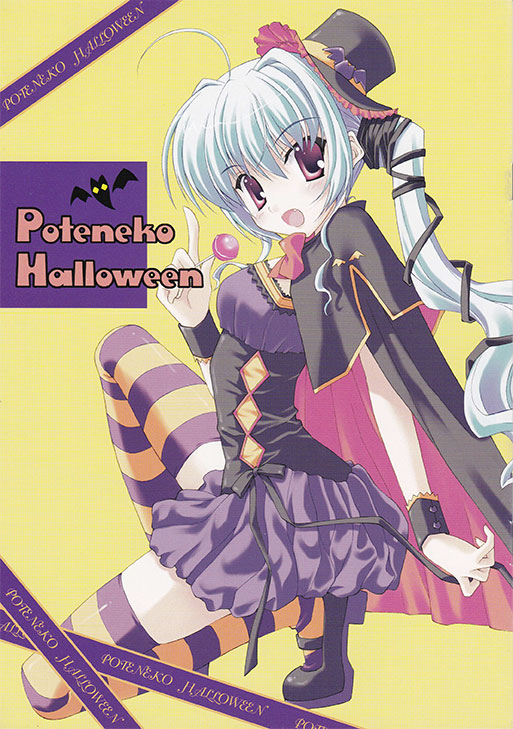
2. Potoneko Halloween by Naru Nanao & KOKONOBI (circle: Ice & Choco)
IMG_20141103_0006Okay, this is something that would normally never pick up, but it was the only book I could find that actually said "Halloween" on the cover, so I just had to get it.
Poteneko Halloween is a book from 2002, and unlike the other books I have been introducing, it's simply a collection of illustrations rather than a manga story. According to the introduction, the artists had produced a variety of goods to go with it, such as a clear file (a plastic sleeve/folder to protect loose sheets of paper) and a decorative plate.
The 6-page insides of the book are fairly similar to the cover: There is one illustration per page, with a small block of text describing the artist's motivations for producing the respective images.
IMG_20141103_0008
From what I can find on the web Naru Nanao is a fairly well known games illustrator, and Kokonobi a frequent collaborator (and former assistant?). The book is full color, and printed on pretty thick stock. It was 100 Yen at Lashinbang, I assume that's because there's not too much content and it's fairly old.
There's a lot of Kancolle illustration on Kokonobi's Pixiv profile, including one for this year's Halloween:
The artists:
Naru Nanao on Wikipedia
Kokonobi on PixivCircle profile
And finally...
3. Kaijuu Wakusei (Monster Planet) by duke
IMG_20141103_0009
What would Halloween be without a good Kaijuu movie?
The story is set on a distant planet inhabited by peaceful creatures. Humans invade, and start harvesting the "Kaijuu" as material for weapons and armor. When one of the beasts, a sort of plant-dragon, being herded into town for slaughter, fights back, it's put into chains and thrown into a dungeon.
There, it encounters a young girl, who has been imprisoned for living together peacefully with the monsters.
IMG_20141103_0011
Soon, she is taken back outside to be crucified publicly.. Until the plant-dragon bursts out of the ground from underneath and starts attacking the soldiers torturing the girl.
The soldiers being powerless against the monster, the town's "king" shows his true colors: He's a Kaijuu himself, having feasted on the monsters for years.
From there on, it's an honest-to-god monster brawl, in the vein of the best of the Godzilla movies.
IMG_20141103_0012
Since I got this book at Lashinbang, I didn't get to look at the insides, and half expected it to be a collection of Kaijuu illustrations. Very pleasantly surprised that it was a proper manga, with great art and a good story. Very satisfying conclusion, too.
Monster Planet is a 44-page story in B5 format, square bound with a semi-glossy 4c wraparound cover. It was 300 Yen at Lashinbang, and well worth it I think!
The artist: duke on PixivTwitter
edit: Forgot one! Here is another "illustration collection" type book by artist kr3:
4. kr+4 by kr3 (Shibano Kaito)
IMG_20141103_0014
A beautiful collection of witch-themed illustrations. The artist points out on the first page that he loves drawing witches, which have a fairly defined general theme. The book features 7 illustrations, including the cover, each covering a different color or element.
IMG_20141103_0015
There's no text or anything, but the illustrations are gorgeous, so I feel it was a steal at 100 Yen.
The artist: Shibano Kaito on the web
That's it for today! Hope you enjoyed this look at a few books a little different from what I usually read.
As always, I welcome feedback and interaction, so I’d be happy if you liked/reblogged, or even commented. Questions and suggestions are welcome!

Sunday, October 26, 2014

Weekend Doujinshi Review, 2014/10/26

Another weekend, another self-published manga review. Make sure to check the doujinshi tag for previous installments!
The doujinshi in this week's post are not from Comitia, but actually from a store! I stopped by Comic Zin in Akihabara with a friend visiting from Canada this week, and of course I couldn't stop myself from getting a few for myself.
Zin is a great store, because they, unlike a lot of other stores, have the erotic, "adult" doujinshi  in a completely different section (read: floor) of the store. As others have pointed out, Akihabara is full of porn, mostly because it attracts more male otaku than female (which is not to say there aren't boatloads of BL doujinshi to be had here too). We visited a few other shops too, but weren't able to find such a good selection of original, non-adult books as Zin had. The West Shinjuku Zin store, by the way, is a fantastic shop as well, and has the adult- and all-ages books clearly separated (albeit next to each other).
On to the books.
1. Kuwagata by Higurashi Mikio
IMG_20141026_0001
Kuwagata, which translates into "stag beetle," is a book about two boys, rambunctious Yusaku and quiet Takaya, spending their summer vacation in the countryside. In the opening scene, they race into one of the boys' grandfather's house with their catch of the day, a huge stag beetle.
Catching large beetles is a hugely popular pastime for young boys in Japan, where insects or all shapes and sizes are ever-present, and is a popular ingredient of the romanticized "perfect" boyhood summer.
IMG_20141026_0003
The beast clocks in at 10cm, beating the previous record of their friend Hana - at which point we start to notice there is a wheel missing from the tricycle. Hana has been away at the training camp of her tennis camp, a fact Yusaku laments vocally.
Hana finally returns the next day, surprising the duo at the creek where they have been hanging out. After she whacks Yusaku over the head with her racket for criticizing her tennis club activities, they get the chance to present their grand victory (the beetle), and she is... utterly unimpressed. Hana is portrayed as, physically as well as mentally, more mature than the boys, and it quickly becomes clear that the relationship between the friends is going to change in a big way...
IMG_20141026_0004
This book is from 2007, but personally I didn't feel like it shows its age at all. It tells a universally recognizable story of the very beginnings of puberty. While the boys, particularly the taller one, are still quite noticeably still children, we get a hint of their development as well when Takaya clearly shows an interest in Hana that goes beyond friendship (and promptly gets heckled by Yusaku for it).
Kuwagata is 20 pages in A5 format, and sold at Zin for 324 Yen. The cover has a beautiful matted finish with a hint of a metallic shimmer that really brings out the blue of the sky and water. The art, while not likely to win any awards, is very fitting for this youthful slice-of-life story.
The artist: Higurashi Mikio (currently going by Ukiwa Yoruno) on TwitterPixivKuwagata at Comics Zin
2. TUBB: 桶の狭間で (TUBB: In between the tubs) by Kasahara Tetsuro
IMG_20141026_0005
Unlike the other books I've been showcasing, this one is actually a side project from an established Manga creator. Kasahara Tetsuro is best known for the manga Rideback, and has been published pretty consistently since 2000.
Oda is a newcomer at a security outfit called "Cucumber" in the distant future, using robotic exoskeletons called "TUBB" (Technical Utility Body Build, nicknamed "tubs") to protect their clients. It's a fairly dystopic world, where desert abounds and global warming has triggered the evolution of gigantic insects. He has been there just short of a month, but is already thinking of quitting, largely due to his insufferable superior, Imagawa.
But not all of Oda's colleagues are as horrible: There's also Nohime, who despite her cute looks is by far the most capable of the TUBB operators due to her military background. True to form, Oda is smitten with her and trots along into hazardous situations obediently.
IMG_20141026_0006
Cucumber's mission du jour is the escort of a team of engineers set to inspect a power plant (power transmission from space via microwaves, in case you were wondering. They encounter a gigantic beetle called a Rhinodon, and with Nohime preoccupied with subduing a panicked Imagawa, it's up to Oda to cut the beast down to size with his trusty chainsaw gun.(!)
IMG_20141026_0007
As I said before, Kasahara is a published pro, and it definitely shows. The art in TUBB is fantastic, the pacing is just right, and the even with the limited space, every single character is relatable and likeable.
The story finishes with Oda looking down at the handily dispatched Imagawa, and the narration saying "I never imagined that I would be shedding tears over this guy only a few months later." I have yet to find a sequel to this, I honestly don't think there is one... Dammit Kasahara!
TUBB is 36 pages long, A5 size, with a matte, textured wraparound cover. Zin is selling it for 630 Yen.
The artist: Kasahara Tetsuro on the webBlogTUBB at Comic Zin
And that's it for today! As always, I welcome feedback and interaction, so I’d be happy if you liked/reblogged, or even commented. Questions and suggestions are welcome!

Monday, October 13, 2014

Comitia 109 haul review 4

Another weekend, another batch of doujinshi I would like to introduce to you. Like the previous ones, all of these are completely original properties, not “fan fiction” type books. If you enjoy this, make sure to check out the previous reviews: 123
1. Remembrance by PLT (circle: i am nebula)
IMG_20141013_0003
circle thumbnail:
IMG_20141013_0004
Remembrance is a set of short stories about two angels and a god, all of whom are depicted as girls dressed in outfits resembling Japanese school uniforms. All of the stories are relatively light on dialogue, and do not delve too deeply into story- or philosophical elements. (also note that this has no religious context whatsoever, despite the subject matter)
For example, the first chapter opens with one of the angels, Koru, observing Saturn through a telescope. The other, Aru, approaches her and comments on why she doesn't just fly up close, where it would be much easier to see. The first angel retorts that she sometimes prefers to experience things just as humans do, with all the limitations that entails.
After a bit of banter about humans and their shortcomings, the two accept each others' points of view, and they head off to Saturn together.
IMG_20141013_0002
The 36-page book is drawn in a style usually reserved for light, comical material (reminiscent of Kill Me Baby), and while Remembrance doesn't go for straight out slapstick, the stories are lighthearted and easy reads. The stories do not interconnect, however the creator suggests in the afterword that they are part of a continuity, albeit out of order.
The art relies heavily on screentones and large-area spot blacks, and is generally well executed, if at times a little loose.
IMG_20141013_0005
I picked this up mostly because I really liked the colors and composition of the cover (see the artist's tumblr for a bigger and nicer version), and while I don't usually read this sort of books it's not something that I dislike.
It's a very light read, and closes with a dark god telling the reader "See you!" as she prepares to smash the world to bits.
It's a A5 book (I seem to have a thing for these), 40 pages, 400 Yen.
Bonus round: Here's a lot at the artist's table at Comitia.
https://twitter.com/plt333/status/505893518343016449
The artist: PLT on TumblrTwitter
2. ROUCHE by Payo (circle: インコ(株) = Inko, Inc.)
IMG_20141013_0007
circle thumbnail:
IMG_20141013_0006
Rio lives in the underbelly of a big city. Feeding herself off scraps from a dumpster, she overhears some guys talk about a painting in some ruins, which they are planning to sell for a fortune.
Hopeful that she might get to it before them, she examines the ruins, but gets caught in the line of fire when a scuffle breaks out between a group of soldiers and some rebels, and hides behind a half-toppled wall in the ruins.
IMG_20141013_0008
There, Rio discovers a mural of a little girl smiling, labeled "Rouche. Immediately, she is ambushed by Ivan, a soldier who, like her, discovered the painting while trying to escape the armed conflict around them.
Over the following days, Rio and Ivan keep returning to the ruins, gradually getting to know each other and making a pact to clean up the painting. But just when they are started to get along, the war catches up to them...
IMG_20141013_0009
The story starts out bleak, and, perhaps realistically for a world in constant conflict, it doesn't end well for the protagonists. The 40-page story wraps up with a flashback illustrating the story of the real-live Rouche, a girl adopted by her uncle when her father gets drafted into the military at the start of war. Her uncle, a painter, vows to protect her, but his promise slowly turns into an obsession that ultimately drives him mad.
The reader is left to draw their own conclusions about what happened to Rouche, where the painting came from, and whether it might have been the curse of her and her uncle's fate that drew Rio and Ivan to the painting, and their demise.
Both art and storytelling are a bit unrefined,  but Rouche still delivers a gut punch or two that makes the book well worthwhile.
I might have actually skipped this book had it not been for the production values: The covers are rounded, and the blank page separating cover and content is a deep shade of blue, with a pattern of silver foil stars embossed on it. It doesn't really have anything to do with the contents, but I really do appreciate when artists go to such lengths to make their books look apppealing. It's an A5 book, 300 Yen.
The artist: Payo on TwitterPixiv
That's it for today! I hope my reviews are helping illustrate how varied and fun Japanese self-published comics can be when you look outside the fan-fiction and porn sections. I will try to keep this on a roughly weekly schedule, so stop by again next week!
Also, I always welcome feedback and interaction, so I'd be happy if you liked/reblogged, or even commented. Questions and suggestions are welcome!
Wednesday, October 1, 2014

Comitia 109 haul review 2

As I mentioned in my last post, I got a ton of books at Comitia 109, and am still slowly working my way through them. Here’s a look at another couple of books from the batch.
1 Melissa by Mephisto (circle: Angraecum)
melissa
Sadly couldn’t find the circle cut, they must have been listed under a different name. The artist states in the afterword that this is his first stab at an original book.
The title character is a girl magically bonded to an “arsenal” housing millions (or billions, depending on who you ask) of the world’s mightiest weapons. She acts as the key to the arsenal, and is thus able to conjure up any of the weapons at wish.
A being of immense worth, and, at the same time, danger, she is confined to a cell on a prison island, which the protagonist (a newly-hired guard who frames the story with a letter to his mother) catches her trying to escape from.
melissa2
From there on, things quickly escalate into an all-out battle, as a sorcerer-soldier from a hostile country (?) attempts to abduct Melissa, and she singlehandedly whoops his ass as the guards stand uselessly by.
melissa3
The art has a dynamic, fairly conventional style, and definitely a little rough around the edges. But not so much as to distract from the story too much. Ultimately, the book reads very much like a prologue. It’s a very, very brief glimpse into Melissa’s universe, and roughs out her character just enough that I might look for a sequel, maybe.  Time shall tell whether we ever see more of her.
But man, that cover. gorgeous.
The artist: Mephisto on the webpixiv, and Twitter
2 雑貨屋 by Biyora (circle: クレープたべたい) (Zakkaya by Crepe Tabetai)
zakkaya
Circle thumbnail:
IMG_20141001_0004
雑貨屋 translates into “general store”, and modernly also refers to a store selling assorted trinkets for home decoration etc. The heroine of the book is a gatherer, who scours the ruins of an ancient city in the “forest of stones” for rare artifacts to sell in her store.
The story starts out with a guy pestering her to get him an “iron flower,” seemingly an everyday item that she has run out of stock of. After some convincing, the heroine agrees to make a run and get supplies.
zakkaya2
It turns out that the “iron flowers” are actually gears (like the ones on the cover), and the artifacts the heroine is selling are various machine parts such as pipes, screws, and cables. Upon returning to town with her bounty, she briefly encounters a friend who bugs her about bringing back machines, which are evil according to her. Except for windmills and weaving machines, which are necessary for life. This leads to a bit of really witty dialogue, as the heroine calls out her friend for being a hypocrite.
She delivers the gear to the guy, who uses it to fix up a mechanism to draw up a big parabolic antenna. Nobody knows what it is, so they just decide it’s a big iron flower, which the ancients built for purposes of… Hanami (picnics under blooming trees).
IMG_20141001_0003
And finally, in the last 4 panels, the story takes a 180 degree turn worth of an M. Night Shyamalan movie. Totally took me by surprise, in an awesome way. I was on the fence on whether to spoil it, since most of you won’t get to read it, but decided against it, in case someone sees this who might. If you want to know more about the book, feel free to contact me.
The whole book is drawn in a deceptively simple, comicky style, but there’s a surprising amount of detail crammed into the art, with purposeful, clear lines that convey a lot of confidence. It’s only 8 story pages, and the story is super compact, well structured, and with great, witty dialogue.
The artist: Biyora on PixivBlog
That wraps up the second round of my doujinshi reviews, hope you enjoyed! Lots more to come, let’s see if I can keep up the pace.

Thursday, September 25, 2014

Comitia 109 haul review

It's been pretty much exactly a month since Comitia 109, but I haven't really had the time to comb through my spoils from the show. I got a pretty good amount of stuff this time around, as you can see in my Instagram from just after the event:
There's a handful of these that stood out for me (as I said I haven't really had the time to comb through them yet, so there might be other hidden gems), so I'll take some time today to tell you about them.
1. kraken by Torimura (circle: Daiouika)
kraken
This was my major new discovery at this year's Comitia. I discovered it in the catalog, decided to check it out, and wasn't disappointed.
The circle thumbnail:
daioika
kraken was actually advertised in the "magazine" section of the catalog too:
Igawa's entire body is covered in bandages, and she is shunned by everyone at school. A mundane encounter leads Higuchi to develop an interest in her, and he discovers her secret. A drive for revenge born out of miscommunication leads to a bitter and tragic end. 
The pain of adolescence, and a giant squid... This strange combination turns out to be really good.
kraken3
Higuchi, a pretty regular guy with a constant group of friends, notices weird, social outcast Igawa after they try to check out the same book about giant squid from the school library. She is being severely heckled by her peers, including the obligatory "die" and "scum" scribbled on her desk, and having her box lunch "accidentally" knocked out of her hands by a fellow student.
They develop a quiet, friendly bond, and she introduces him to her after-school project: Building a mechanical giant squid to destroy the school, their peers, and everything in its way.
kraken4
The 72-page story is drawn in a deformed, scribbly style with simplified faces and expressive, big eyes. there's a lot of well-placed spot blacks, and purposefully loosely-cut screentones. The story moves at a fairly leisurely pace, and concludes in a destructive inferno that, while not entirely original, feels just right for the book.
Obviously my main impulse for buying this book was the cover. It's amazingly designed with a great 5-color palette, a matte finish in the compact A5 size. I liked it so much that I asked the artist to sell me the display copy when I heard it was sold out. She sold out of it early in the day, apparently she had completely underestimated the demand (not suprising, since it was only her second show, and likely the first time she was featured this heavily in the catalog).
The story pages are a fairly heavy, matte paper as well, and overall it's a very attractive package. I believe it was 500 Yen.
Artist: Torimura on Twitter Pixiv
2. iromonia by usamimiki (circle: R-Panda)
iromonia
This was a chance find, I just walked by their booth and there it was. Turns out I had already purchased another one of her books, 恐竜肉食少女時代(lit. "The age of girls who eat dinosaur meat")at Comiket. I guess her style just instantly clicks with me.
R-Panda's circle thumbnail:
rpanda
iromonia is about a blind little girl who gets picked up by a robot small-time criminal, who offers to take her back to her home town in exchange for her eyeballs (which he intends to sell on the black market).
iromonia2
When she opens her eyes to allow the robot to take out her eyeballs, he is stunned by their beauty, and changes his mind, attempting to leave her be. In the girl's youthful naivete, however, she tags along with him, and with the help of a friend, they set course for her hometown. It's the tried-and-true formula of no-good adult and innocent child sidekick on a roadtrip, and true to form it's not long before things go awry.
I bought this mostly for the art, which is beautiful with lots of detail and parallel hatching, as well as great character designs, especially for the robots. It's about 80 pages for I think? 500 yen. The cover is beautiful with stark contrast of the white-faced girl against black background, and a logo embossed in silver foil. At one point in the story, the book actually goes full color for two pages to illustrate the girl's emotions, and it just blew me away. It even came with a separate little booklet featuring design sketches and comments. I'm amazed at how well this book is put together.
iromonia3
But the art is not the only beautiful thing about iromonia. The story of a 2-bit street thug getting more and more enthralled by the sincerely innocent little girl, and trying to make things right for her, only to realize he has no place in her life, is heartwarming and ultimately heartbreaking. It had me very, very close to tears by the end.
If you can find anything by this artist, I highly recommend checking it out.
Artist: Usamimiki on web and Pixiv
And that's it - my two favorite picks from this year's summer Comitia! Hope you liked them.

Wednesday, August 20, 2014

Comic Market 86

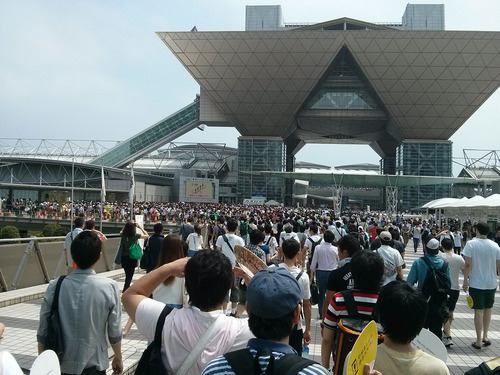
Last weekend, I spent a few hours at the famous Comic Market. It's a huge, confusing event, but it can be a lot of fun, so I decided to write up a little post about what I know, so you can skip some of the figuring-it-out stage if you intend to visit, or just imagine you were there.

image

Comic Market, abbreviated Comiket or コミケin Japanese, is Japan's biggest comic convention. Calling it a convention, however, might create some confusion for people who are familiar with American or European comic cons... There is no big, elaborate publisher booths, panels, or signings with creators.
In fact, the japanese term for this type of event is 即売会, which loosely translates into "on-the-spot sale meet." 

The entire event is essentially what is known at conventions outside Japan as artist's alley. Exhibitors attend it mainly to sell their doujinshi, amongst some other goods and apparel.
doujinshi sold at Comiket can be anything from a few copies stapled together, to full blown artbooks, but the vast majority are leaflets of about 30 pages or so, with a full color cover and black & white inside pages, in A5 or B5 size. 

image

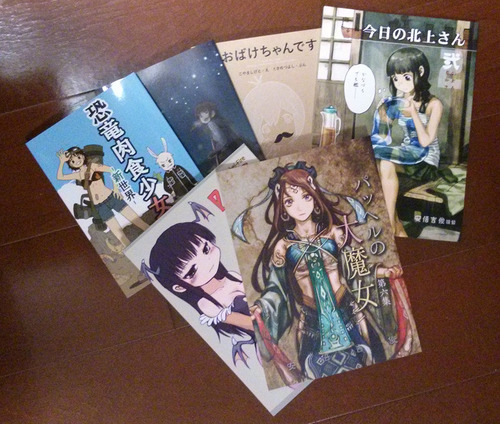
This is my haul from Sunday. The small (A5) books in the upper left, which amazingly have about 80 pages, cost 400 yen, or about $4. The bigger (B5) ones with about 30 pages were still only 500, and the one in the top right, which has full-color insides, was 1,000 Yen. These B5 books are from Serial Experiments Lain and Haibane Renmei creator ABe Yoshitoshi, some samples from the insides are up on his Pixiv account if you want to check them out.

There's a lot of on-demand printing services that are very easy to use and dirt cheap. Depending on the paper quality and amount of copies you produce, it's entirely possible to make a beautiful 30+ page book for not much more than 100 Yen per book.

Some relatively unknown creators I talked to mentioned they had done a print run of about 200 copies, while superstar creator Akamatsu Ken of Love Hina and Negima! fame mentioned selling about 8,000 copies before 1pm.

image

Comiket is held at Tokyo Big Sight, a huge convention hall with an exhibition space of 80,660 square meters (868,217 square foot) For comparison, the dealer floor at San Diego Comic-Con is 460,000 square feet = 42,700sqm. It's held twice a year, typically in August and December

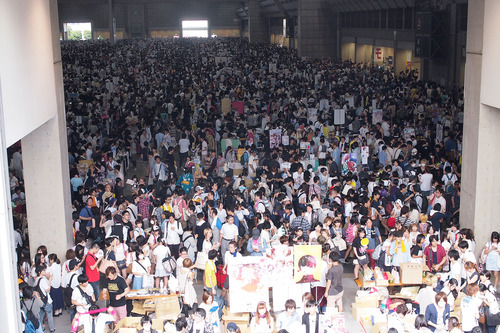
This year's summer Comiket claims to have had 550,000 visitors. I'm not entirely sure how they count that, since there are no tickets (just gigantic open gates), and rumor has it they keep the numbers artificially low to avoid problems with fire protection law and the like. Either way, it was a madhouse.
An official report said there were over 10,000 people camped out overnight for the first day this year. 
But of course it wouldn't be a convention without exhibitors - this year, the official Comiket publicity twitter account reported around 35,000 circles were attending. That's mindblowing, considering that the chance for winning the attendance lottery is supposed to be around 50-70%.

What's a circle, you ask? Circle, in this context, refers to a group of people who share a passion for a subject (such as an anime series or a videogame), enough to band together and produce doujinshi together. 

As you might have heard, the term doujinshi, spelled 同人誌 in Japanese, literally translates into "same people magazine." For years, I just assumed that this referred to a book featuring characters from an established property (thus the "same people"). But then I found out that there's lots and lots of original properties being told in the same format, and they're also called doujinshi. So I put the question to Twitter, and one of my Japanese acquaintances explained that the "same people" doesn't refer to the characters, but the people comprising the circle, who share the same interests. Mind blown!

image

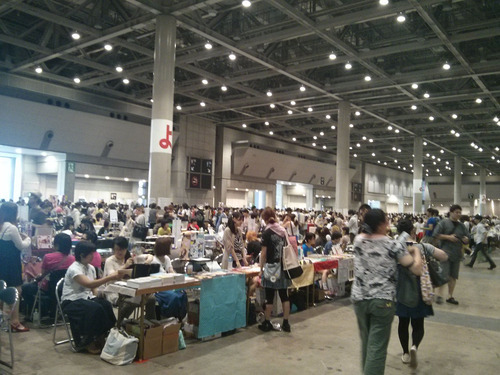
Each booth, or "space" as it's called at Comiket, comes with a narrow table, and two chairs. Most exhibitors do little to spice up their booth, some add a table cloth, maybe a little standee banner, but nothing too fancy. Obviously, the books are the main attraction here.

There is very little aggressive selling. Very few people will ask you to take a look at their books, and asking someone to buy is actively discouraged.  

Which brings up the question, how the hell do you find anything in this huge place, when there's so little clues?

Obviously it's easier if you know a creator that you want to go visit. They'll have announcement up on their blogs, Twitter, or Pixiv (the Japanese equivalent of Deviantart). A lot will even change their Twitter handle to include the booth number, like so: 安倍吉俊/3日目東A41a,b "Abe Yoshitoshi, 3rd day, East A41a,b." So Abe Yoshitoshi can be found on the 3rd day of the event, in the East hall, A41 a and b. Note that while the event is 3 days, each circle is only represented on one of them.

What if you're not looking for a specific creator, but a genre, for example, say, a Naruto fanbook? The halls are divided by genre, 42 rough categories, and similar books will usually be grouped together. The category for Naruto and other Shounen Jump books will be FC(少年).

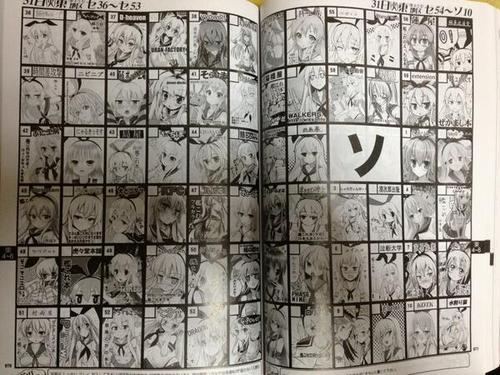
So you know the category now, and if you're only there for one category you might as well just go to that area of the event and browse. But say you want to narrow it down a little more. There is a catalog available before the event, sold at book- and anime stores etc. for about 2000 Yen. As you can probably imagine from having seen manga magazines, the catalog is pretty close in dimensions to a phone book. And the insides look like this:

image

Yeesh. This is a page in the Kancolle section, featuring doujinshi of the popular character Shimakaze. It has the row number (ソ, note that there will be alphabet, hiragana and katakana row numbers), and then a single image for every circle to present their visual style, with the booth number and circle name. That's all the hints you get. If you find one that piques your interest, it can't hurt googling the name and see if they have a twitter or Pixiv account which might feature some more samples of their work.
It's a pretty daunting task.

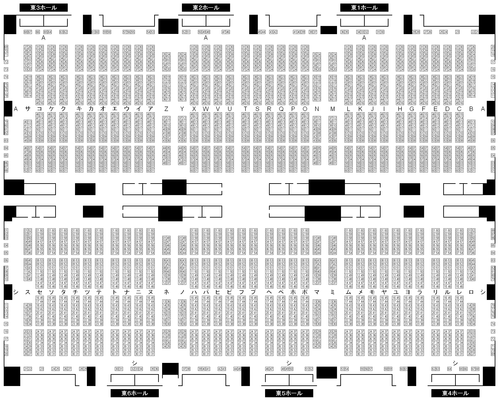
Here's a look at one of the halls' floor plans:

image

Notice how the "A" section is hugging the walls, with a broad-ish corridor between it and the rest of the tables? This is where the bigger, well-known circles get to exhibit. They tend to draw larger crowds, so they are positioned in ares where they can form lines (which usually extend out of the huge gates) without blocking the other exhibitors' booths. The ends of the rows are similar, as they also offer more space and a clearer view of the booth.

As you can imagine, a lot of the Shimakaze books on the catalog page above are adult books, which is something that doujinshi are very commonly associated with. And rightly so, this is definitely a big part of Comiket's wares. 

But there is so much more to be found. Obviously there are other, non-adult themed fanfiction doujinshi, but there is also a ton of other content. A small list of things I discovered in my very cursory browsing of this year's Comiket, after I was done checking out the creators I had planned in advance, directly from my twitter updates:

Travel essays, train photos, anti-TPP propaganda leaflets, screenplays... this is #comiket too. UFO magazines. Tons of them for the believers. Restaurant review booklets. Recipe collections. Flute playing instructions. Stickers. Charms. Papercraft. Handmade dolls. Handmade bags, purses and earrings. T-shirts. Rubber stamps. 

The above is from a span of about 20 minutes of my tweets. There is a vast amount of content to be found for all tastes, if you manage to find it in the limited amount of time available: Comiket opens at 10 and closes at 4pm. As I mentioned above, over 10,000 people spend the night in the parking lot overnight and flood the venue all at once, so even entering before noon is literally impossible.
I usually try to be there about 12:30 - 1pm. The crowds are still absolutely crazy, but there's no wait to actually enter the venue, and it's possible to navigate without getting squashed. Popular books start selling out around 2-3pm, at which point the exhibitors pack up and go home, so some research into what you plan to look at is a must. 

Also, there's two areas of the event that I haven't touched upon: The commercial booths and cosplay areas. The commercial booths, 企業ブース in Japanese, are put up by publishers, anime companies and apparel/goods vendors.

image

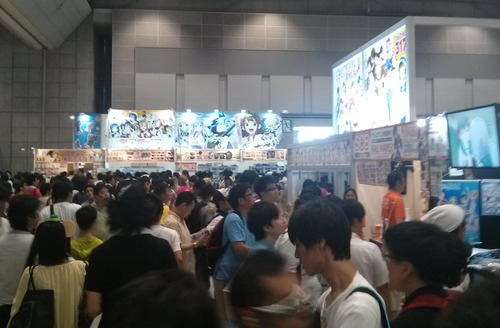
Unlike the publisher and TV booths at an american convention, there are no talkshows, meet-and-greets, or any activity other than sales here. All there is are limited edition goods (anything from printed tumblers to the notorious 抱き枕 - long pillows with a print of an anime character on them) to be bought, and people gladly line up for an hour to get to them. Honestly, even going up there isn't worth it. There's too many people, and very little to see.

The cosplay area(s), on the other hand, are a different story. There's tons of really elaborate, great cosplay here, but the thing is that it's separate from the dealer floor (aside from a select few people wandering around in costume, and a few aisles of cosplay photo books and DVDs being sold). The Comiket rules dictate that cosplayers need to change into their costumes on site (there are dressing rooms available), and cosplayers then pose for photographers in a roped-off area outside specifically reserved for that purpose. It's huge, and there's like 20 photographers with huge DSLRs crowding around each scantily clad girl, but I can tell you little else because I haven't really bothered to go in myself. My understanding is that you actually have to get a permit on site to take pictures (a result of Japan's rampant trend of taking unwanted pictures, and extreme protectiveness of ones portrait rights, and generally personal information). So I'll leave that up to someone more in-the-know to describe.

That's it! Pretty much all I know about Comiket! Let me know via Disqus or the Ask me feature in case there's anything you want me to elaborate on. I'll be happy to help!
(ported from my tumblr)